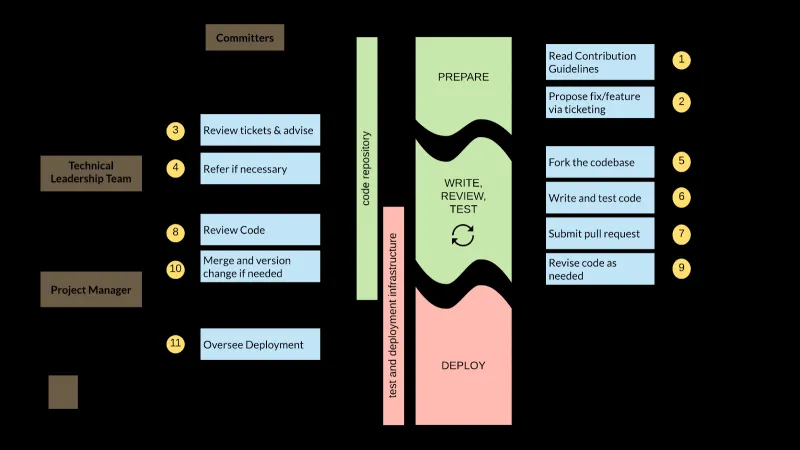
The Contributor Pipeline: How Arora Transforms Curious Users Into Browser Maintainers
Most open-source projects post a CONTRIBUTING.md file and call it an onboarding strategy. Arora Browser decided that wasn't enough.
Over the past several development cycles, Arora has quietly built something more deliberate: a structured contributor pipeline that takes people with no prior browser development experience and moves them — methodically, with support at every stage — toward meaningful ownership of production code. The results are reshaping what community-driven browser development can look like.
The Problem With Traditional Open-Source Onboarding
The conventional path into open-source contribution is, charitably, informal. A motivated developer finds a project, reads whatever documentation exists, attempts to set up a local environment, hits an undocumented dependency conflict, posts a question to a mailing list or forum, waits several days for a response, and — if they haven't given up — eventually submits a pull request that may sit unreviewed for weeks.
For a browser project specifically, the barriers compound. Browser codebases are among the most technically complex software systems in existence. Even experienced developers who work daily with JavaScript, Rust, or C++ can find themselves disoriented by the architecture of a rendering engine or the layered security model that governs process isolation. The cognitive overhead is real, and it has historically kept browser development a domain reserved for a relatively narrow technical elite.
Arora's program was designed with that friction explicitly in mind.
Scoped Entry Points: The "Good First Issue" Is Not Enough
The good-first-issue label on GitHub has become something of a running joke in developer communities. Too often, issues tagged this way are either trivially cosmetic — fixing a typo in a README — or, conversely, require enough architectural understanding that they aren't genuinely approachable for newcomers at all.
Arora's approach is more granular. The project maintains a tiered issue taxonomy that distinguishes between documentation contributions, test coverage additions, UI-layer changes, and core engine work. Each tier comes with an explicit prerequisite checklist: what a contributor should understand before attempting the issue, which parts of the codebase they'll touch, and who the designated mentor reviewer is for that category of work.
This taxonomy means a first-time contributor who arrived at the project primarily as a privacy-conscious user — someone who may have no professional software development background — can find genuinely useful work that doesn't require understanding how Arora's network stack handles certificate pinning. They might start by improving the documentation for a privacy settings panel they already use daily. That contribution matters. It ships. And it earns them the context and credibility to attempt something more technically demanding next time.
Mentorship Infrastructure That Actually Functions
Documentation can lower barriers, but it cannot replace human guidance. Arora's program pairs each new contributor with a named maintainer during their first three pull requests. This isn't an informal "feel free to ask questions" arrangement — it's a structured commitment. Mentors are expected to respond to review requests within 48 hours, to provide inline code commentary that explains why a change is requested rather than simply flagging that it is, and to schedule a synchronous check-in if a contributor's PR has stalled for more than a week.
The mentorship load is distributed across the maintainer team, with each active maintainer carrying no more than two first-time contributors at any given time. That ceiling is intentional. Overloading experienced contributors with onboarding work is one of the fastest ways to burn them out and collapse the very infrastructure that makes the pipeline work.
Contributors who complete their first three merged PRs are graduated to a "peer review" tier, where they begin reviewing other newcomers' work under light supervision. This transition serves two purposes: it reinforces their own technical understanding through the act of teaching, and it begins building the reviewer capacity the project needs to sustain growth without bottlenecking on a small group of senior maintainers.
Community Rituals That Reduce Isolation
One underappreciated dimension of contributor attrition is psychological rather than technical. Open-source contribution can feel profoundly isolating, particularly for someone who is new to the domain and uncertain whether their work is valued. Arora has invested in community rituals specifically designed to counteract that isolation.
Bi-weekly contributor calls — held in US-friendly time zones with recorded archives for those who cannot attend live — give newcomers a face and a voice behind the usernames they interact with in code review. A dedicated channel in the project's community forum surfaces recent first-time merged contributions and acknowledges them publicly. The acknowledgment isn't performative; it's accompanied by a brief technical note from the reviewing maintainer explaining what the contribution accomplished and why it mattered.
These rituals signal something important: that the project is paying attention, and that the work of a junior contributor is not merely tolerated but genuinely integrated into the project's direction.
What the Data Shows
The program's outcomes are measurable. In the twelve months since Arora formalized this contributor pipeline, the project has seen a sustained increase in the ratio of first-time contributors who go on to make a second contribution — a metric that proxy-measures whether the initial experience was positive enough to warrant continued investment. Historically, open-source projects see the majority of first-time contributors make exactly one contribution and disappear. Arora's structured approach has meaningfully shifted that ratio.
More telling is the trajectory of contributors who entered the pipeline without prior browser development experience. Several individuals who began by submitting documentation corrections or accessibility improvements have, within eighteen months, progressed to owning discrete subsystems — including privacy-relevant components like the tracker blocking heuristics and the permissions management interface. That progression doesn't happen by accident. It happens because the infrastructure was designed to make it possible.
Why This Model Matters for Browser Privacy
The connection between contributor pipeline design and browser privacy may not be immediately obvious, but it is direct. A privacy-focused browser depends on sustained, skilled community oversight of its codebase. When the contributor base is narrow — when only a handful of experts have the context to audit and improve the code — the project becomes brittle. A single maintainer's departure, or a period of reduced capacity, can stall critical security work.
Broadening the contributor base is therefore not merely a community health exercise. It is a privacy infrastructure decision. Every developer who moves from casual user to capable maintainer represents an additional set of eyes on the code, an additional voice in architectural discussions, and an additional source of institutional knowledge that doesn't evaporate when any single person steps back.
Arora's program is a bet that the best way to build a browser people can trust is to build a community that earns that trust — one merged pull request at a time.
Getting Started
If you're reading this as someone who uses Arora regularly but has never considered contributing to its development, the program described here was built for you as much as for any junior developer. The project's contributor documentation is available at arora-browser.org, and the tiered issue taxonomy is maintained in the primary repository. Mentors are currently accepting new contributors across all tiers.
The first commit is always the hardest. The infrastructure exists to make it less hard than you'd expect.