Why Most Developers Never Make Their First Browser Commit — And How Arora Is Changing That
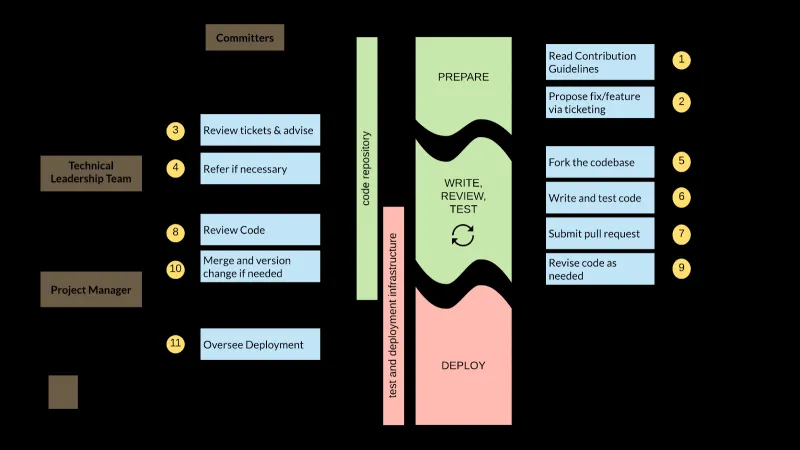
Photo: developer onboarding open source code contribution collaboration, via esipfed.github.io
There is a particular kind of discouragement that does not arrive loudly. It does not come as a rejection letter or a hostile code review. Instead, it surfaces in the third hour of reading undocumented legacy C++ headers, or in the moment a developer realizes that the project's contribution guide was last updated during a different administration. For the vast majority of developers who have considered contributing to an open-source browser, the experience ends not with a conflict but with a quiet tab closure.
That pattern has consequences. Browser engines sit at the foundation of the modern web, and the health of those projects depends on a sustained influx of contributors who bring fresh perspectives, diverse expertise, and genuine investment in the outcome. When the contributor pipeline narrows to a small circle of specialists with years of institutional knowledge, the project calcifies — technically and culturally.
Arora Browser was built with the explicit understanding that accessibility to contribution is not a courtesy feature. It is an engineering requirement.
The Documentation Trap
Ask any mid-level developer why they abandoned an attempt to contribute to a major browser project, and documentation will surface within the first few sentences. Not the absence of documentation, precisely — most large projects generate enormous volumes of written material. The problem is documentation that was written by experts for other experts, organized around the mental models of people who have already internalized years of project history.
Architecture overviews that assume familiarity with the rendering pipeline. Build instructions that reference internal tooling without explanation. Glossaries that define terms using other undefined terms. Each of these represents a friction point that, individually, might be manageable. Accumulated across a first contribution attempt, they constitute a genuine barrier.
Arora's documentation strategy treats clarity as a technical specification, not an editorial aspiration. Contributor guides are reviewed not only for accuracy but for comprehensibility by developers encountering the codebase for the first time. When a documentation pull request is submitted, maintainers evaluate whether a developer six months into their career could follow the instructions without supplementary context. That standard is deliberately demanding, and it produces guides that actually function as guides.
The Unwritten Rules Problem
Every mature open-source project develops cultural norms that govern how contributions are received, how disagreements are resolved, and which voices carry informal authority. In many projects, these norms are never written down. They exist in the collective memory of long-term contributors and express themselves through terse code review comments, unanswered pull requests, and the subtle social temperature of community forums.
For a developer outside that inner circle, navigating these unwritten expectations is genuinely difficult. A technically sound contribution may be declined for reasons that are never articulated. A well-intentioned question in a community channel may receive a response that communicates irritation without explanation. These experiences do not need to be overtly hostile to be effective deterrents.
Arora's community guidelines address this directly. Expected review timelines are published and maintained. Code review feedback is required to be specific, constructive, and referenced to documented standards where applicable. Community moderators are empowered to intervene when interactions fall below those standards, and that authority is exercised visibly enough that contributors understand it is real rather than ceremonial.
Issue Labeling as Infrastructure
One of the most practical interventions in contributor accessibility is also one of the least glamorous: the systematic labeling of issues by complexity, required expertise, and mentorship availability. This is not a novel idea. The "good first issue" label has existed across GitHub for years. What distinguishes effective implementations from performative ones is the discipline applied to their maintenance.
Labels that are applied inconsistently, or that describe issues as beginner-friendly when they require deep subsystem knowledge, erode trust faster than having no labels at all. A developer who invests several hours in an issue tagged as accessible, only to discover that resolving it requires understanding of the browser's memory allocator, is less likely to try again than one who encountered no label at all.
Arora's issue triage process includes a dedicated review step for contributor-facing labels. Issues marked as appropriate for first-time contributors are verified against a checklist that considers codebase surface area, required background knowledge, and the availability of a named maintainer willing to provide guidance. That last criterion matters. A labeled issue without an available mentor is a different proposition than one with a specific person committed to answering questions.
Structured Mentorship as a Retention Mechanism
Labeling addresses discoverability. Mentorship addresses the experience of actually attempting the work. Arora's contributor mentorship program pairs developers who have expressed interest in a specific area of the codebase with maintainers who have agreed to provide structured support through the contribution process.
This is not an informal arrangement. Mentors commit to response time expectations, maintain a documented log of guidance provided, and participate in a periodic review of the program's effectiveness. Contributors who complete a mentored contribution are invited to remain engaged as informal advisors for subsequent contributors working in the same area, creating a layered support structure that scales without requiring proportional growth in senior maintainer time.
The data on mentorship-supported contributions is encouraging. Contributors who complete a first contribution through the mentorship program return for a second contribution at a substantially higher rate than those who navigate the process independently. The initial investment in structured support pays dividends in sustained engagement.
Why This Is a Competitive Argument, Not Just a Moral One
It would be easy to frame contributor accessibility as an ethical imperative — and it is — but the competitive dimension deserves equal attention. Browser development is technically demanding, and the pool of developers capable of contributing meaningfully is not unlimited. Projects that make contribution unnecessarily difficult are not merely being unwelcoming; they are voluntarily narrowing their own talent pipeline.
For a privacy-focused, open-source browser operating in a market dominated by projects with enormous corporate backing, the ability to attract and retain contributors from across the developer community is a genuine strategic asset. Every developer who successfully makes a first contribution to Arora and returns for a second is a resource that no acquisition budget can replicate: someone who understands the codebase, shares the project's values, and has demonstrated a willingness to invest their time in its future.
Lowering barriers to contribution is, in this framing, a form of competitive infrastructure investment. The return is measured not in quarterly earnings but in the depth and breadth of the community that sustains the project over time.
The Work That Remains
Arora does not claim to have solved the contributor accessibility problem. Build times remain long. Certain subsystems carry genuine complexity that no amount of documentation can fully abstract away. The gap between a developer's first issue and their first substantial architectural contribution is real, and bridging it requires sustained effort from both the project and the contributor.
What Arora does claim is a commitment to treating that gap as a problem worth solving systematically, rather than a natural filter that separates serious contributors from casual ones. The browser that earns the trust of developers is the one that treats their time and effort as worthy of a deliberate, well-maintained welcome. That is the standard Arora holds itself to — and the standard against which it expects to be judged.